Competitions
There are regular local, national and international competitions available for students once they have achieved 9th kup yellow tag.
You can compete in Sparring, Patterns or Destruction (depending on your age and grade). I never push students into taking part in competitions, although I do encourage everyone to at least give it a go once – it is a great experience, and even the smallest of successes can be a big boost to confidence. I also encourage my black belts to qualify as umpires and referees and to volunteer at competitions – without the volunteer officials, TaeKwon-Do competitions simply couldn’t happen! It is an opportunity to give back to the art we all love.
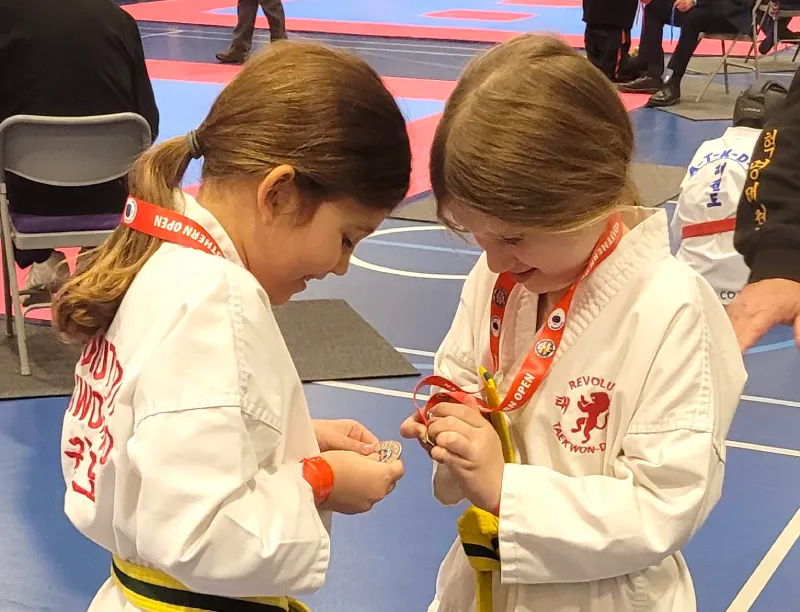
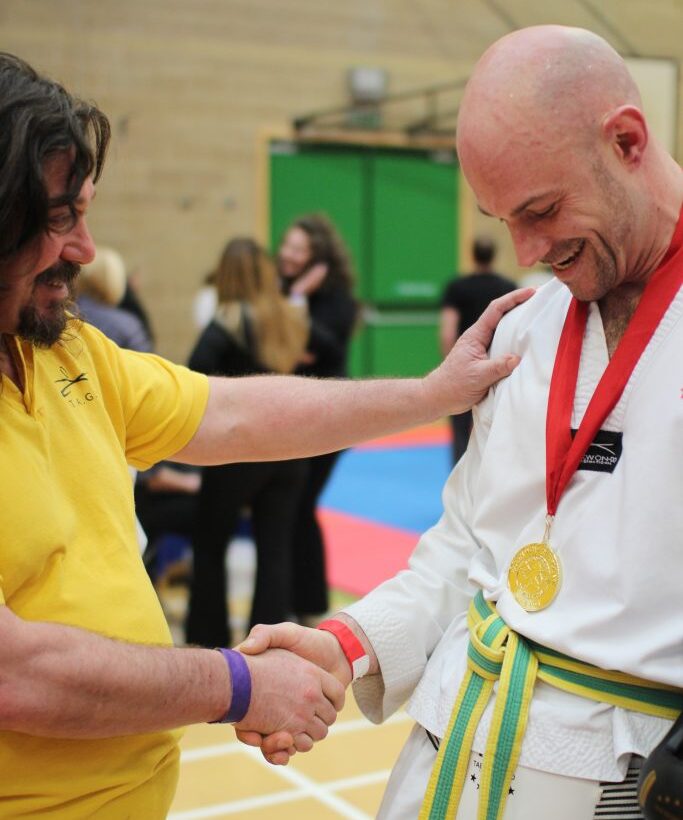
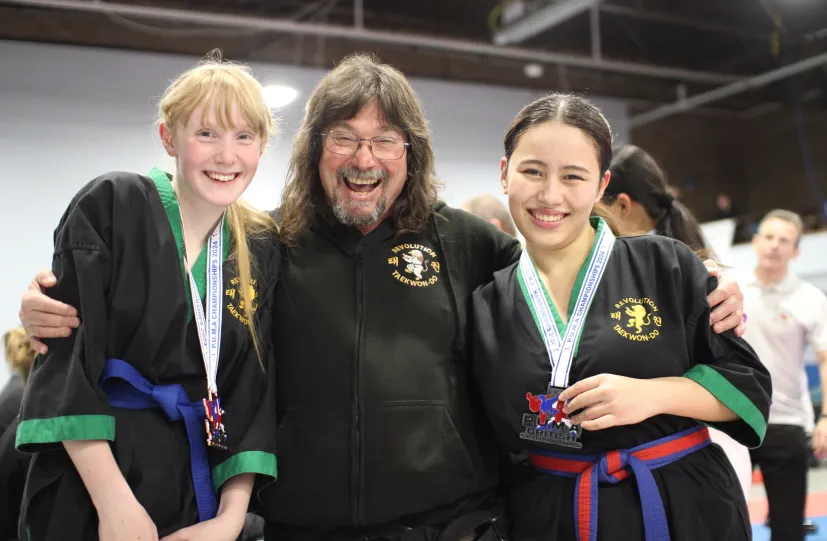
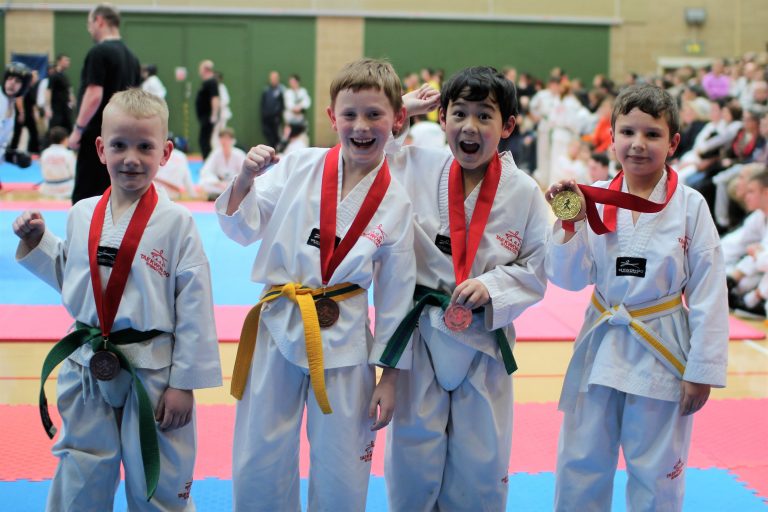
My students often return with medals and trophies from local and national competitions, and I have even had two students become world champions.
There are two different types of TaeKwon-Do sparring – full contact and semi-contact.
Full contact sparring
This is what you may have seen on TV (such as at the Olympics) – this is full contact fighting (hitting as hard as possible to hurt and/or knock out) and does not use hand techniques to the head. This style of TaeKwon-Do is known as WT (World TaeKwon-Do). WT also performs a different style of patterns to us – called poomsae. The modern Olympic sparring is easily recognised by the full body armour worn – which also includes electronics to aid in scoring.
Semi-contact Sparring
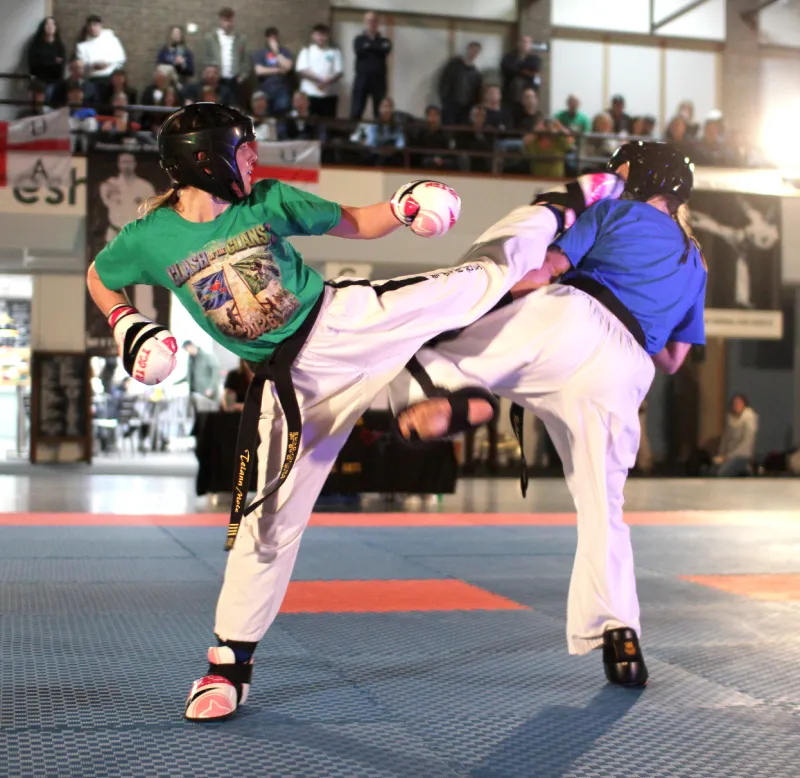
We practice semi or ‘touch’ contact sparring, which is similar to that used in modern kickboxing –semi-contact, meaning we are not trying to hurt our opponent. We don’t wear full contact body armour (as used at the Olympics). We do wear protective sparring kit though. It is the student’s responsibility to ensure that all sparring kit fits and has no rips or tears!

What Can You Compete In?
Sparring:
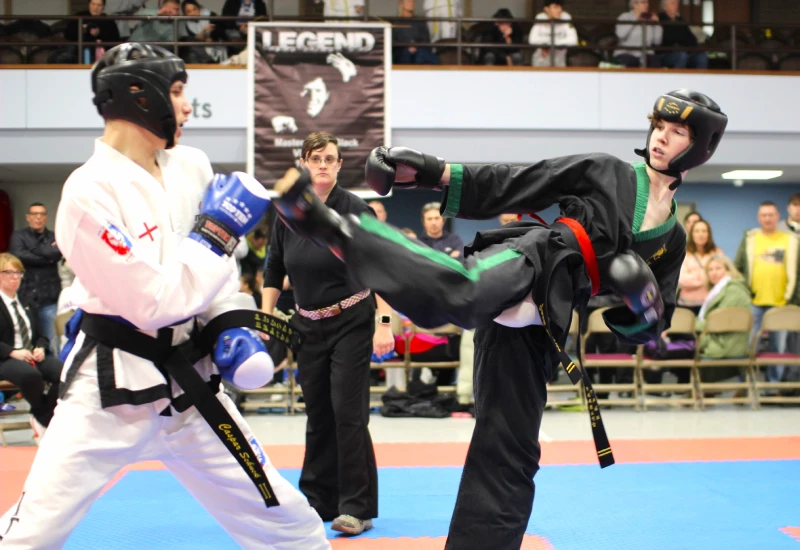
Sparring is the main event in most TaeKwon-Do competitions. This is done at a semi contact or ‘touch contact’ level, this means that nobody is attempting to actually hurt, knock out or draw blood at all. Contestants who are seen to be going too hard in competitions are warned and then disqualified. This type of sparring is also performed regularly in class; as well as training for the competition side of TaeKwon-Do, it is a good way to develop and experience fighting in a controlled way – all sparring is very closely monitored by experienced instructors.
Competitors are split into divisions at competitions – for sparring this is done by gender, age (there may be a junior/cadet/adult split), grade (sometimes several grades may be in the same division together, depending on the size of the competition) and either height for junior students, or weight for cadets and adults. The divisions vary at each competition – depending on the organiser and the amount of anticipated entries.
There are very definite rules in competition sparring, as well as the ‘not attempting to hurt’ rule; we wear protective equipment (gloves, head guard, foam boots, shin guards, gum shields and groin guards for men and boys). There is no kicking below the belt, no sweeping/catching kicks/tripping or take-downs, no grabbing at all – we do not grapple in competition. We attack only with our hands and feet (no knees or elbows) and the target areas are the front of the body and all of the head.
There are two different types of sparring bouts – ‘point stop’ and ‘continuous’. Point stop bouts are often aimed at the more junior grade students (up to blue tag) and/or children. Essentially, when a competitor scores a point the fight is stopped to add up the points, and then re-started. Continuous fighting, as the name suggests, doesn’t stop when points are scored (there may be stoppages for rule infringements, competitors losing balance or the occasional injury!) instead the bout continues for the usual 90 seconds, with 2 – 4 corner judges totalling up the points they see scored.
Team (or Tag Team) Sparring: Often entered on the day (rather than in advance), tag team competitions are a lot of fun! Teams are usually made up of 3 to 5 competitors, same sex and similar grades/heights/weight/ages (with a definite split between junior and adult competitors). The bouts run on a point stop basis, with team members ‘tagging’ in and out during the bout. The sparring bouts are longer – often 4 minutes, and during the bout each team member must fight at least once.
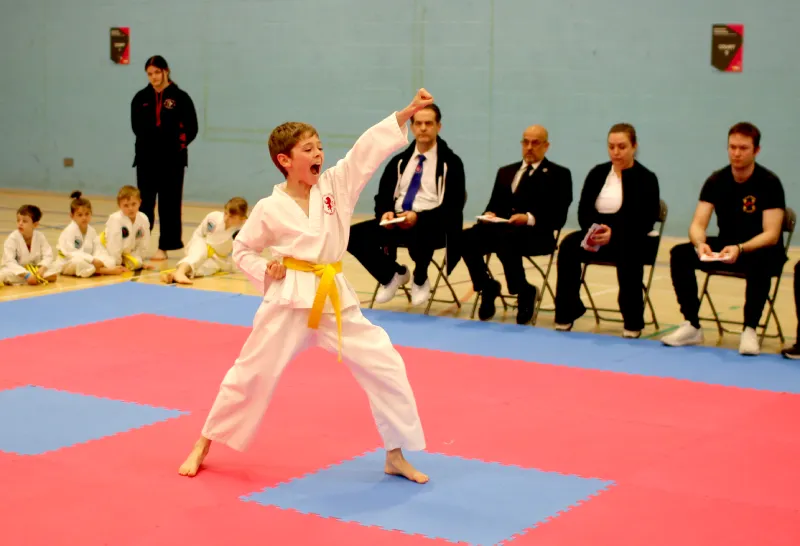
Patterns: As well as sparring, students can also compete in patterns divisions. Patterns (also known by their Korean name of Tul) are combinations of TaeKwon-Do moves put together in a set routine (in Karate these patterns are known as Kata). Competitors are judged on using the correct moves, performance of technique (chamber/height), stance, power, focus and fluidity of movement. A pause of a few seconds will disqualify you! Different competitions will judge patterns using different methods – some will ask two competitors to perform the same pattern simultaneously and will vote which was the best/worst, while others will score each individual on their own.
Team Patterns: Again often entered on the day of the competition, teams are usually made up of 2 – 5 competitors, who are expected to perform most of the pattern in unison, though also some extra points can often be gained by performing some sections individually before returning to matched timing once more.
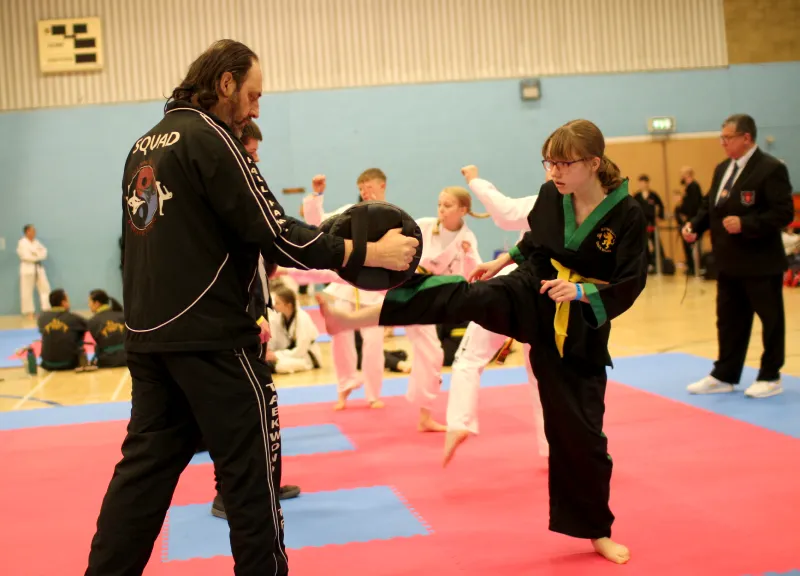
Speed Kick: Some competitions include this event for the junior competitors. Individuals have to perform as many front leg turning kicks against a hand pad in thirty seconds as they can – touching down to the floor each time.
High Kick: Again this is a junior only event which is held at some competitions. A ball is suspended on a string which is adjusted based on the competitor’s height. The competitor tries to kick the ball whilst keeping their supporting foot on the floor (no jumping!).
Destruction: This is the ‘breaking’ of boards to demonstrate power and correct technique (and how daft you are!). The boards are made of plastic and are slotted together in the middle – creating a fault line allowing the board to be ‘broken’. Competitors can often enter to break using a hand or foot technique – the techniques used will vary at different competitions. Sore hands and feet are common! This event is only allowed for adults, and generally is only available from blue belt and above.
We will inform students about forthcoming competitions – keep an eye on our calendar page! Each competition is likely to have its own set of rules which we will try to provide a link to also.